

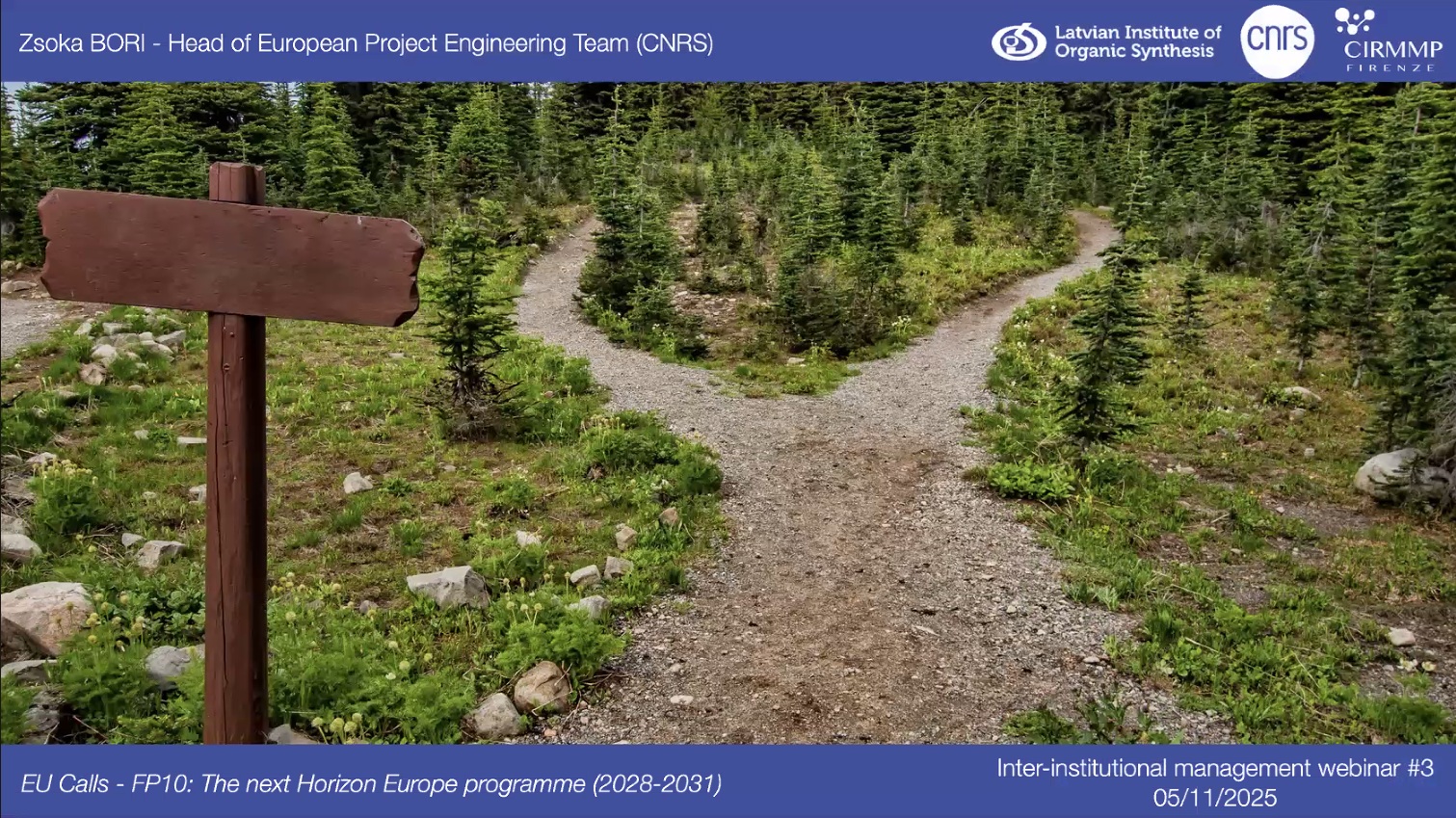
Date: 5 November 2025
Time: 10:00–11:00 CET
Format: Online (Zoom)
The MR LATVIA team was pleased to host the 3rd Inter-Institutional Management Webinar, dedicated to Pre-Award EU Grant Management — an essential topic for researchers and project managers involved in European research collaborations. The event brought together participants from across Europe to share insights on building successful EU project proposals, managing the pre-award process, and developing effective research partnerships.
Expert Contributions
The webinar featured three distinguished speakers from leading European research organisations:
- Raphaële Coulon, European Project Manager at the Centre national de la recherche scientifique (CNRS, France), opened the session with an overview of the structure and logic behind EU calls, providing practical advice on identifying suitable opportunities and initiating the consortium-building process.
- Zsoka Bori, Head of the European Project Engineering Team at CNRS (France), continued the discussion by addressing key elements of consortium strategy, including partner engagement, coordination mechanisms, and early communication practices that help strengthen proposal competitiveness.
- Francesca Morelli, Director and Senior European Project Manager at the Consorzio Interuniversitario Risonanze Magnetiche di Metallo Proteine (CIRMMP, Italy), shared best practices in Open Science and collaborative proposal writing. Her presentation highlighted how transparent communication, shared data management, and accessibility principles underpin successful European research collaborations.
In addition to exploring the current EU funding landscape, the session included a forward-looking discussion on the Next EU Framework Programme (FP10, 2028–2034). The experts shared practical recommendations and experiences from managing large-scale European projects, with a focus on the following aspects:
Building a Strong Consortium
- Start identifying potential partners early — developing a robust consortium takes time.
- Build a reliable core team and expand strategically around it.
Building on Previous Projects
- Leverage results and partnerships from previous or ongoing projects.
- Engage with coordinators of similar initiatives to build on existing synergies and avoid duplication.
Creating a Strong Framework
- Allow researchers to concentrate on scientific excellence by partnering with experienced project managers who can provide a 360° perspective on proposal design and coordination.
Ensuring Project Balance
- Ensure geographical balance and diversity among partners, including both academic and industrial organisations.
- Promote gender equality, disciplinary diversity, and complementarity across the consortium.
- Multidisciplinary approaches help foster creativity and co-creation of innovative solutions.
Clear Role Definition
- Define partner roles and responsibilities clearly at the proposal stage to maintain coherence and avoid redundancy throughout the project lifecycle.
Open Science Practices
A dedicated part of the discussion focused on Open Science principles, encouraging transparent and accessible research while safeguarding sensitive data.
The concept was well summarised in the phrase: “As open as possible, as closed as necessary.”
The session concluded with an open discussion and Q&A, allowing participants to exchange perspectives on the practical challenges and opportunities of EU project development. The dialogue underscored the importance of early strategic planning, effective communication, and a collaborative mindset in successful grant acquisition.
This webinar was organised as part of the MR LATVIA project (Development of Magnetic Resonance in Latvia) — a collaborative initiative aimed at strengthening Latvia’s research capacity in magnetic resonance and fostering international scientific excellence.
Project partners:
Funded under the HORIZON-WIDERA-2023-ACCESS-02 programme, MR LATVIA supports collaboration, knowledge exchange, and capacity building across European research infrastructures.
The presentations from the session are now available:👉 [Access the Presentations Here]