

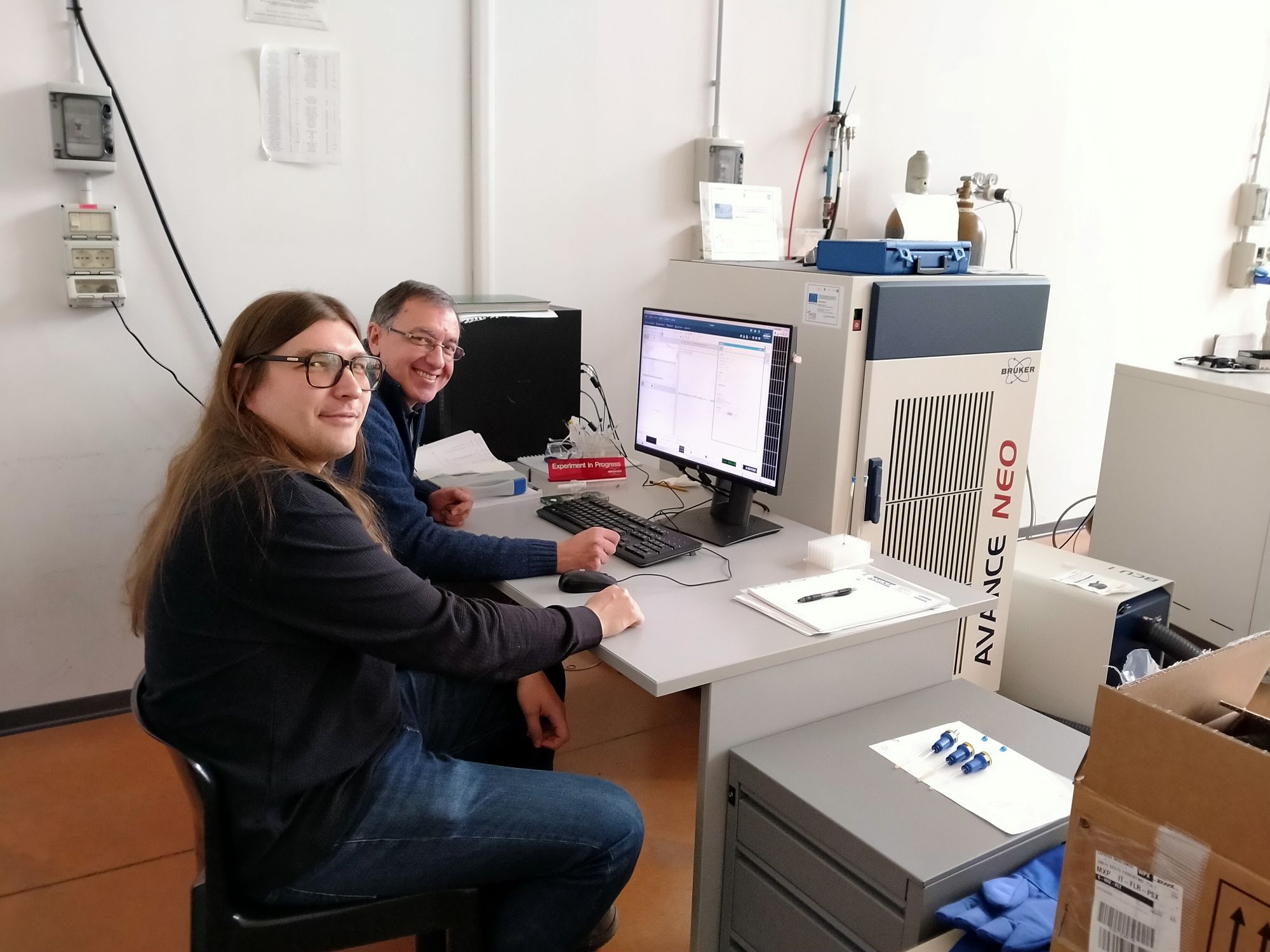
Ruslans Muhamadejevs completed a focused two-day technical visit to the CERM/CIRMMP NMR Research Infrastructure in Florence, one of Europe’s leading centres for high-field NMR science. The visit strengthened ongoing collaboration and provided a valuable opportunity to exchange hands-on expertise in ultra-high-field instrumentation, operational workflows, and data management practices.
Day 1 – High-Field Operations & Solid-State Setup
The programme began with a warm welcome and an in-depth facilities tour led by Marco Schiavina, offering an overview of CIRMMP’s capabilities and current high-field research developments.
A highlight of the day was participating in the helium refill of the 1.2 GHz NMR spectrometer, guided by Massimo Lucci and Rebecca del Conte. This rare opportunity provided important insight into the cryogenic procedures and safety requirements associated with operating one of the world’s highest-field NMR instruments.
After an informal lunch with the technical staff, the afternoon was dedicated to the setup of solid-state NMR equipment on the 1.2 GHz platform. This session offered practical experience with probe installation, configuration, and calibration steps essential for ultra-high-field solid-state measurements.
Day 2 – Solution NMR, Data Workflows & Collaboration
The second day focused on solution-state NMR operations, with Fabio Calogiuri presenting protocols, best practices, and instrument-specific considerations for high-resolution solution measurements.
Following lunch, Enrico Morelli introduced the group to CIRMMP’s data management, archiving, and transfer workflows, illustrating how the infrastructure ensures secure, consistent, and reproducible data handling across projects.
The visit concluded with an open discussion session, enabling a productive exchange of experiences between the visiting team and CIRMMP experts. The conversation highlighted shared challenges and opportunities for deepened collaboration in high-field NMR research.